
The "Time Management Master" of Cement Slurry for Well Cementing
2026-03-06 10:45:46
Click:
“
Kelioil retarder CH610 can effectively control the setting time of well cement, enabling your well cementing operations to be carried out smoothly and continuously.
”
CH610 is a high-temperature polymer retarder independently developed by Kelioil, integrating advanced polymer synthesis technology and field application experience, which is specifically designed for high-temperature deep well cementing operations. It is applicable to high-temperature deep wells with a bottom hole temperature below 302°F (150℃), covering various oil and gas well cementing scenarios such as conventional high-temperature deep wells, offshore high-temperature wells, and saline formation wells. As a core innovation product of Kelioil in the field of high-temperature cementing additives, CH610 breaks through the technical limitations of traditional retarders, fills the gap in domestic polymer-based high-temperature retarders, and realizes localized substitution, providing a reliable technical guarantee for safe and efficient high-temperature deep well cementing operations.
In the field of oil and gas exploitation, high-temperature deep well cementing puts extremely high requirements on the performance of cement slurry. The key to ensuring the safety and quality of cementing lies in effectively regulating the thickening time of cement slurry to match the construction cycle. Conventional compound retarders such as glucose and phosphate have been widely used in cementing operations, but they often show obvious defects under high-temperature conditions, which are difficult to meet the strict requirements of high-temperature deep well construction. Compared with these traditional compound retarders, CH610 has outstanding advantages in performance stability, adjustability and high-temperature adaptability, and has become an ideal alternative to traditional retarders in high-temperature deep well projects.
Its outstanding advantages are mainly reflected in the following two aspects:
Firstly, its thickening time shows an excellent linear relationship with the dosage, and the dosage is insensitive with good adjustability. This is the core technical breakthrough of CH610. Traditional compound retarders such as glucose and phosphate often have nonlinear mutations in thickening time when the dosage changes slightly, which leads to great difficulties in on-site construction control. Even a small error in dosage may cause the thickening time to be too short or too long, further leading to construction accidents such as stuck pipes or poor cementing quality. In contrast, CH610 adopts a unique polymer molecular structure design, which makes the thickening time of cement slurry increase stably and linearly with the increase of dosage. Engineers can accurately calculate the required dosage according to the actual well depth, temperature and construction cycle, and flexibly adjust the thickening time within a reasonable range. The insensitivity to dosage also reduces the risk of construction errors caused by slight fluctuations in dosage, greatly improving the controllability of cementing construction and reducing the material waste caused by dosage errors.

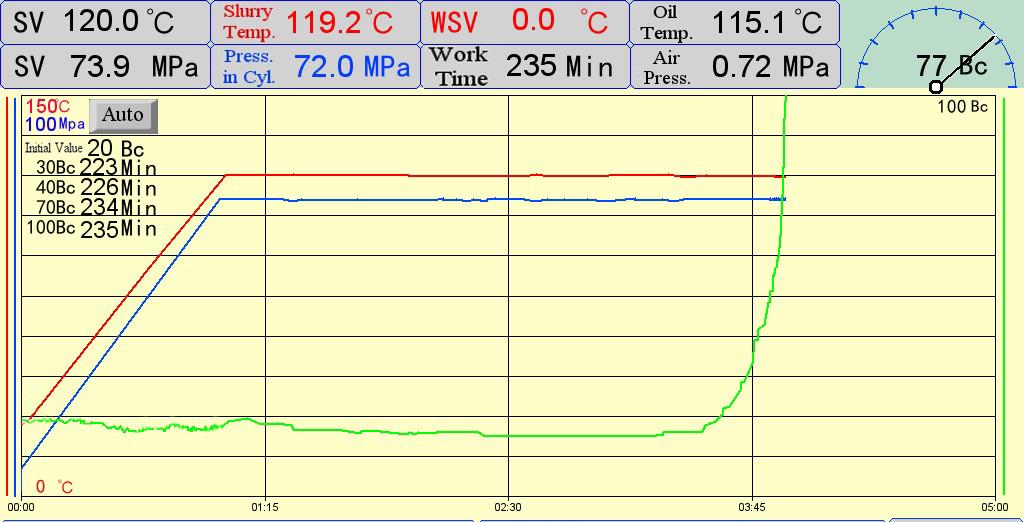
Secondly, the mutation value of the high-temperature thickening curve is small, and it is less likely to have defects such as bulges and steps. Under high-temperature conditions (close to 150℃), conventional compound retarders are prone to thermal degradation or unstable molecular structure, which leads to abnormal phenomena such as 'bulges' and 'steps' in the thickening curve of cement slurry. These defects will seriously affect the rheological properties of cement slurry, resulting in uneven hydration of cement slurry, easy occurrence of 'core wrapping' phenomenon, and further affecting the bonding strength between cement stone and wellbore, endangering the long-term sealing reliability of the wellbore. CH610 optimizes the temperature-resistant chain segment of the polymer, which significantly improves its thermal stability under high-temperature conditions. The thickening curve remains smooth and stable during the entire cementing process, with a small mutation value. Laboratory tests and on-site application data show that the mutation value of the thickening curve of CH610 under 150℃ is ≤10 Bc, which can effectively avoid the occurrence of bulges, steps and other defects, ensure the uniform hydration of cement slurry, and lay a solid foundation for improving the cementing quality.

In addition to the above two core advantages, CH610 also has excellent compatibility and environmental safety. It can be used synergistically with various cement additives such as dispersants, fluid loss reducers and gas channeling preventers without antagonistic effects, and is suitable for various cement systems such as G-grade and H-grade cement, as well as fresh water to saturated salt water systems. At the same time, CH610 is made of environmentally friendly polymer materials, does not contain toxic components, has good biodegradability, meets API and oil industry HSE specifications, and is more competitive in environmentally sensitive areas such as offshore platforms.
In summary, CH610 high-temperature polymer retarder, with its excellent linear adjustability, stable high-temperature performance, good compatibility and environmental safety, has become a benchmark product in the field of high-temperature deep well cementing additives. It not only solves the technical pain points of traditional compound retarders in high-temperature environments, but also provides a more efficient, safe and reliable solution for high-temperature deep well cementing operations, promoting the technological progress of the oil and gas exploitation industry.



Author:
Tianjin Kelioil Engineering Material and Technolog
0
